

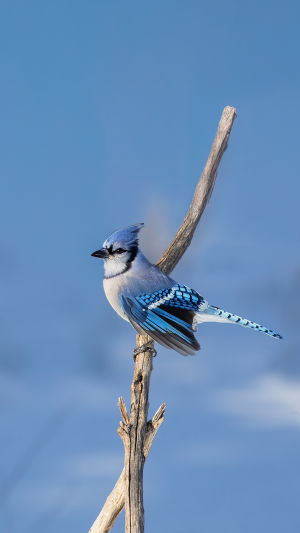
If you’ve ever spotted a vibrant blue bird hopping through your backyard, you’ve likely met a Blue Jay, Cyanocitta cristata.
With its striking blue plumage, expressive crest, and bold personality, this bird often captures the attention of birdwatchers and casual observers alike.
Yet, beyond its brilliant feathers, the Blue Jay exhibits a host of fascinating behaviors and adaptations that make it one of North America's most intriguing songbirds.
<h3>Distinctive Appearance and Communication</h3>
<b>1. Vibrant blue feathers</b>
Contrary to what you might think, the blue color of a Blue Jay's feathers isn't from pigment. Tiny microscopic structures in the feathers scatter light to produce the vivid blue hue, a phenomenon known as structural coloration. This makes each sighting uniquely dazzling depending on sunlight and angle.
<b>2. Complex vocalizations</b>
Blue Jays are exceptional mimics. They can imitate raptor-like calls, which they sometimes use to deceive other birds into thinking a predator is nearby. This clever vocal strategy can help them protect food sources or alert other birds to real threats.
<b>3. Expressive crest</b>
The crest on a Blue Jay's head isn't just decorative. It reflects the bird's mood—when the crest is raised, the bird may feel aggressive or excited, while a flattened crest often signals calmness or submission. Observing these subtle cues provides insight into their social interactions.
<h3>Behavior and Intelligence</h3>
<b>1. Food caching</b>
Blue Jays are known for their habit of storing acorns and other nuts for later consumption. They have remarkable spatial memory, often retrieving hundreds of hidden food items across days or weeks. This behavior also contributes to forest regeneration, as forgotten nuts can sprout into new trees.
<b>2. Problem-solving skills</b>
Observations and research suggest that Blue Jays can solve multi-step problems to obtain food. They may figure out how to access tightly closed feeders or work through simple puzzle-like obstacles, showing flexible learning and persistence.
<b>3. Social dynamics</b>
These birds often move in family groups or loose flocks outside the breeding season. Within these groups, they may cooperate to chase away threats and share information about food, revealing sophisticated social behavior.
<h3>Survival Strategies</h3>
<b>1. Predator awareness</b>
Blue Jays are alert and adaptable. Their sharp eyesight and loud warning calls help them detect and deter predators, keeping themselves and other birds in their vicinity safe.
<b>2. Territorial defense</b>
During nesting season, Blue Jays can become fiercely territorial. They defend their nests with coordinated calls, physical displays, and even by chasing intruders, ensuring the safety of their eggs and young.
<b>3. Adaptation to human environments</b>
Blue Jays are highly adaptable to suburban and urban areas. They readily use bird feeders, parks, and gardens, and their intelligence allows them to thrive in environments where other species may struggle.
Observing a Blue Jay in action offers more than just a visual delight—it reveals the remarkable combination of intelligence, adaptability, and social behavior that defines this species. Their playful curiosity, striking appearance, and clever survival strategies make Cyanocitta cristata a bird worth appreciating in every backyard or woodland it calls home. Next time you hear a sharp, melodic call from the trees, take a moment to watch—you might witness ingenuity, communication, and sheer avian charm all in one bird.


