

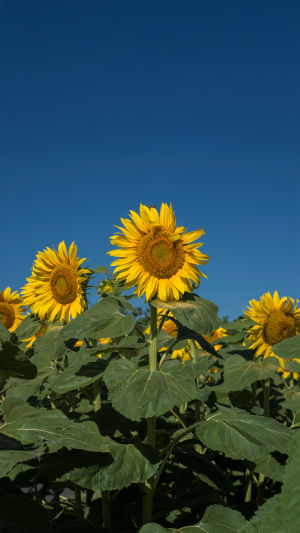
Spring gardens and open fields come alive with sunflowers, whose tall stems and radiant yellow faces capture the eye.
These iconic blooms are more than decorative—they are examples of nature's intricate design and adaptability.
Sunflowers have inspired art, science, and agriculture for centuries, and their unique traits make them a subject of fascination for gardeners and botanists alike.
From solar tracking to ecological contributions, these flowers combine beauty with functionality, standing as one of nature's most efficient and captivating creations.
<h3>Following the Sun</h3>
Young sunflowers exhibit a behavior called heliotropism, in which their flower heads turn to follow the sun across the sky from east to west each day. This movement maximizes sunlight absorption for photosynthesis, promoting rapid growth. Interestingly, this solar-tracking is controlled by differential growth: the stem elongates on the shaded side of the flower, causing the head to tilt toward the light.
As the plant matures, the head typically faces east permanently. This eastward orientation warms the flower early in the day, attracting more pollinators such as bees, which prefer warm flowers. This fascinating interaction demonstrates how a plant's behavior can directly influence its survival and reproduction.
<h3>A Flower of Many Flowers</h3>
Although a sunflower appears as a single large blossom, it is actually a composite flower made up of hundreds to thousands of smaller florets packed tightly in the central disk. Each of these florets is a complete flower capable of producing seeds.
The arrangement of these florets follows a precise geometric pattern, often a Fibonacci spiral, which maximizes space and ensures even exposure to sunlight. This efficient design allows a single sunflower head to produce hundreds of seeds, highlighting the plant's impressive reproductive capacity.
<h3>Record-Breaking Growth</h3>
While most garden sunflowers grow between 5 and 12 feet tall, under optimal conditions, some varieties have reached over 30 feet, earning entries in world record books. These giants require plenty of sunlight, well-drained soil, and consistent watering. Sunflowers are hardy plants that can tolerate moderate drought once established, making them suitable for a wide range of climates.
Their rapid growth and impressive height not only make them visually striking but also practical as natural windbreaks and soil stabilizers.
<h3>Colorful Varieties</h3>
While golden yellow is the most iconic color, sunflower cultivars display a broad palette, from deep burgundy and bright orange to creamy white. Some varieties, such as “Moulin Rouge” or “Italian White,” offer garden enthusiasts creative options for arrangements or themed flower beds.
In addition to visual appeal, different colors may attract different pollinators, further demonstrating the sunflower's adaptability and ecological importance.
<h3>Ecological Champions</h3>
Sunflowers play a critical role in supporting pollinators, attracting bees, butterflies, and other beneficial insects with their abundant nectar and pollen. They are often planted as companion plants to improve crop pollination and biodiversity.
Beyond pollinators, sunflower seeds provide food for birds and small mammals, creating mini-ecosystems around cultivated fields. Additionally, sunflowers are used in phytoremediation, a process in which plants remove contaminants like heavy metals from soil, demonstrating their environmental value beyond aesthetics.
<h3>Patterns in Nature</h3>
The intricate spirals of sunflower seeds are not random—they follow mathematical patterns that optimize seed packing. These spirals often align with Fibonacci numbers, showcasing a fascinating intersection between mathematics and nature.
This design allows maximum number of seeds in minimal space and ensures efficient nutrient distribution. Observing a sunflower closely reveals how beauty and function are deeply intertwined in natural systems.
<h3>Conclusion</h3>
Sunflowers are more than cheerful garden companions—they are symbols of resilience, adaptability, and harmony with the environment. Their solar-tracking behavior, complex floral structures, and ecological contributions remind us of the delicate balance and intelligence inherent in nature.
Walking through a sunflower field is both visually uplifting and thought-provoking, offering insights into how life thrives when aligned with natural rhythms. These golden blooms encourage us to seek light, grow toward opportunities, and contribute positively to the world around us.


