

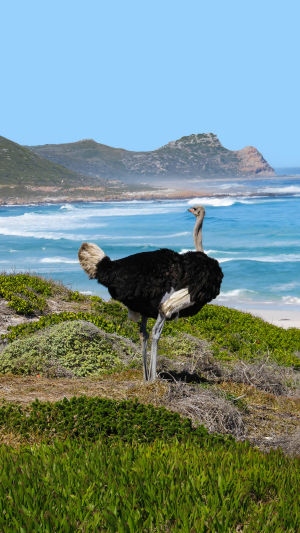
You’re watching a nature documentary. The narrator says, deadpan, “An ostrich’s brain is smaller than its eye.” You pause, rewind, and wonder: How is that even possible? And if it’s true, how does this bird survive in the wild with what sounds like a serious design flaw?
Let’s clear this up fast: yes, it’s true. A mature ostrich’s eyeball measures about 5 centimeters (2 inches) in diameter—roughly the size of a billiard ball. Its brain is only about 4 centimeters long and weighs around 40 grams.
So technically, the eye is bigger by volume. But before you write off the ostrich as a feathered fool, there's more to the story.
<h3>Why big eyes? Survival, not vanity</h3>
Ostriches live in open savannas and semi-arid plains where predators like lions, cheetahs, and hyenas roam. With almost no cover to hide in, their best defense is spotting danger early. Their massive eyes sit high on their skull, giving them a near 360-degree field of view. Each eye has a high density of photoreceptors, letting them detect movement from over 3 kilometers away. That's like seeing a person waving from across six football fields. Not bad for a "bird-brain."
And here's the kicker: their eyes aren't just big—they're efficient. The optic nerve is thick, sending visual data to the brain faster than in many mammals. So while the brain itself is compact, it's wired to prioritize what matters: motion, distance, and threat level.
<h3>Running, not thinking, is their superpower</h3>
When danger shows up, ostriches don't stop to ponder. They bolt. At speeds up to 70 km/h (43 mph), they're the fastest two-legged animal on land. Their stride can cover 3 to 5 meters per step—imagine leaping the length of a small car with every bound. This escape strategy works because it's automatic, not calculated. Their nervous system is built for reflex, not reflection.
Their legs are another marvel. Each foot has just two toes (most birds have three or four), which reduces drag and increases stability at high speed. The inner toe even has a claw sharp enough to fend off attackers if cornered. So while their brain may be small, their body is a precision-engineered survival machine.
<h3>Brain size ≠ intelligence—here's why</h3>
The myth that "bigger brain = smarter" is stubborn, but it's outdated. What matters more is brain structure, neuron density, and how the brain connects to the body. Crows, for example, have walnut-sized brains but can solve multi-step puzzles and recognize human faces. Octopuses have distributed intelligence—two-thirds of their neurons are in their arms.
Ostriches don't need complex problem-solving skills. Their world runs on patterns: find food (seeds, plants, insects), avoid predators, breed, repeat. Their brain is streamlined for that loop. It's not "dumb"—it's specialized. Think of it like a sports car: not built for hauling cargo, but unbeatable on the track.
Also, consider this: relative to body size, an ostrich's brain is actually average for a bird. Some songbirds have proportionally larger brains, but they live in complex social groups and need to learn songs or remember food caches. Ostriches? They graze in loose flocks and rely on vigilance, not gossip.
<h3>So why does the myth stick?</h3>
Because it’s catchy. “Brain smaller than its eye” sounds absurd—and absurd sticks in your memory. It also feeds into the old idea that birds are instinct‑driven automatons. But modern research shows many birds display planning, empathy, and tool use. The ostrich just plays a different game.
That said, they do have one odd habit: when hiding, they sometimes lie flat and press their necks to the ground. From a distance, it looks like they’ve buried their heads in the sand—a myth that’s totally false, by the way. They’re just trying to blend in, and their eyes stay wide open the whole time.
So next time someone jokes about an ostrich’s tiny brain, you can say, “Yeah, but those eyes? They’re basically high‑definition radar dishes. And those legs? Built like Olympic sprinters. The brain’s just along for the ride—and it’s doing exactly what it needs to.”
Funny how nature doesn’t care about our ideas of “smart.” It only cares about what works. And for the ostrich, seeing far and running fast beats overthinking every time.


