

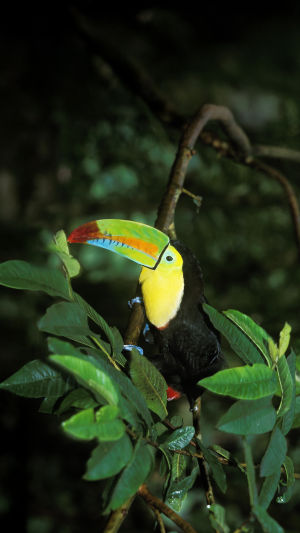
In the tropical rainforest, one bird always stands out at first glance—the Keel-billed toucan with its bold and colorful beak.
At first, we may think it’s just a striking feature, but the more we explore, the more we realize this oversized beak is actually a masterpiece of nature.
Every detail has a purpose, and the Keel-billed toucan’s beak is one of the most fascinating survival tools we can discover together. Let’s break down why this beak is far more than just eye-catching.
<h3>Light as a Feather, Not Heavy at All</h3>
At first glance, the beak looks thick and heavy. Surprisingly, it is incredibly light. Even though it can grow up to one-third of the bird’s body length, its structure is mostly hollow. Inside, we find a network of tiny, sponge-like structural supports, while the outside is covered with a thin keratin layer.
Because of this smart design, the beak only weighs a few dozen grams. That means it doesn’t slow the bird down or make flying difficult. We can think of it like a strong but lightweight bridge—big in size, but efficient in structure. This completely changes our usual idea that “bigger means heavier.”
<h3>An All-in-One Feeding Tool</h3>
Now let’s talk about how useful this beak really is. Along the edges, there are fine serrations that act like tiny teeth. These help the Keel-billed toucan break open tough tropical fruits with ease.
Inside, a long and flexible tongue allows it to reach and grab fruit pulp precisely. Whether it’s picking fruit from high branches, catching insects hidden between leaves, or even grabbing small reptiles, the beak handles it all.
What makes it even more impressive is that the bird doesn’t need to move its whole body much. With just a stretch of its beak, it can reach food that would otherwise require effort. We can see it as a built-in tool that saves energy and increases efficiency.
<h3>A Natural Cooling System</h3>
Living in a rainforest means dealing with constant heat. Unlike humans, Keel-billed toucans don’t sweat. So how do they cool down? The answer lies in their beak.
The beak is filled with tiny blood vessels. When temperatures rise, blood flows through the beak and releases heat into the air. This works like a natural cooling system.
In fact, this cooling method is extremely efficient. By adjusting blood flow, the Keel-billed toucan can control how much heat it releases. It’s like having a built-in temperature regulator, helping it stay comfortable even in hot conditions.
<h3>A Key to Attraction and Communication</h3>
The beak also plays an important role during the mating season. A larger and more colorful beak often signals better health and stronger survival skills. This makes the Keel-billed toucan more attractive to potential partners.
During courtship, the male may use the beak to offer fruit to the female. This simple action becomes a meaningful interaction, showing care and ability.
So, the beak is not just a tool for survival—it also helps build connections and communicate fitness within the species.
<h3>Colors That Never Fade</h3>
One of the most striking features of the Keel-billed toucan’s beak is its bright color. We might think these colors come from pigments, but that’s not the full story.
The colors are actually created through structural reflection. Light interacts with the surface in a way that produces vivid shades like yellow, red, and blue. Because of this, the colors don’t easily fade over time.
This makes the beak not only functional but also visually stunning, maintaining its brilliance throughout the bird’s life.
<h3>A Smart Defense Strategy</h3>
When facing danger, the beak becomes a clever defense tool. Its large size can make the Keel-billed toucan appear bigger and more intimidating than it actually is.
This visual trick can confuse or scare off potential threats. Instead of relying on speed or strength alone, the bird uses appearance as part of its survival strategy.
It’s a great example of how nature combines form and function in unexpected ways.
<h3>More Than Just a Beak—A Survival Masterpiece</h3>
When we put everything together, we can see that the Keel-billed toucan’s beak is far from a simple feature. It is lightweight, versatile, cooling, expressive, colorful, and protective—all in one.
Every detail has a purpose, perfectly adapted to life in the rainforest. It reminds us that nature doesn’t waste design—everything has a role to play.
So Lykkers, next time we see a Keel-billed toucan, let’s not just admire its looks. Let’s appreciate the hidden brilliance behind that giant beak. Which feature surprised us the most?


