

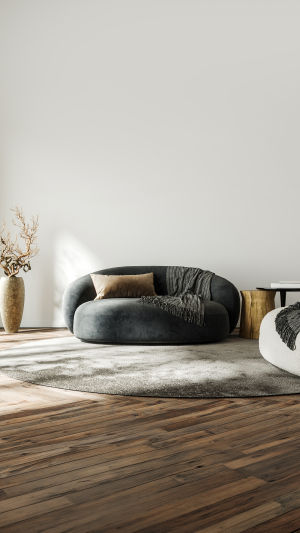
Most people respond to a small room by trying to solve the problem with storage — more shelves, more baskets, more containers for the things that make the space feel cluttered.
This addresses the symptom but not the cause. A room does not feel small because it contains too many objects.
It feels small because the visual signals it sends — the way the eye moves through the space, where it stops, what it cannot see past — create an impression of constraint. Change those signals and the same square footage reads completely differently, without removing a single wall.
The good news is that the principles behind making a small room feel larger are consistent, learnable, and almost entirely about perception rather than construction.
<h3>Color Does More Work Than Any Piece of Furniture</h3>
The single most impactful change available in a small room costs less than any furniture purchase and can be reversed on a weekend. Wall color determines how the eye perceives depth, and using it strategically produces changes in spatial perception that no arrangement of furniture can match.
Light, cool colors — pale blue, soft grey, warm white, and muted sage — push walls visually outward because they reflect more light and recede from the eye. Dark colors do the opposite, advancing toward the viewer and compressing the perceived space. This does not mean dark colors cannot be used in small rooms — a single dark accent wall on the wall furthest from the entrance can actually add depth by creating visual distance — but covering all four walls in a deep tone reliably makes any room feel smaller.
Painting the ceiling the same color as the walls, or slightly lighter, removes the visual boundary between wall and ceiling and makes the room feel taller. A ceiling painted in a contrasting color draws attention to the boundary and lowers the perceived height of the room.
<h3>Furniture Scale and Placement Change Everything</h3>
The instinct in a small room is often to fill it with small furniture — petite chairs, narrow side tables, compact sofas — on the assumption that smaller pieces take up less visual space. This instinct is partially correct but frequently taken too far. A room filled with many small pieces of furniture reads as cluttered and busy. One or two larger, well-chosen pieces read as confident and spacious.
The more useful principle is to choose fewer pieces of appropriate scale rather than many pieces of reduced scale. A sofa that fits the room proportionally, with clear floor visible on at least two sides, will make the room feel more generous than a smaller sofa surrounded by multiple side tables, ottomans, and accent chairs.
Furniture legs matter significantly. Pieces with visible legs — sofas, chairs, and tables that show the floor beneath them — allow the eye to travel under the furniture and across the full floor surface. This continuous floor plane makes the room feel larger. Pieces that sit directly on the floor or extend to the ground block that sightline and visually reduce the room's floor area.
<h3>Light, Mirrors, and Vertical Lines</h3>
Natural light is the most powerful spatial expander available, which makes window treatments one of the highest-impact decisions in a small room. Curtains hung at ceiling height rather than at window frame height make the window — and the wall it sits on — appear taller. Curtains that extend wider than the window frame allow more of the wall to remain visible when the curtains are open, making the window look larger and bringing in more light.
Mirrors amplify whatever light is present by reflecting it back across the room, effectively doubling the visual depth of the space. A large mirror on a wall opposite a window reflects both the natural light and the view through the window, creating the impression of an additional opening in the room. The mirror needs to be large enough to be convincing — small decorative mirrors distributed across a wall produce a different effect, adding pattern rather than depth.
Vertical lines draw the eye upward and make a room feel taller. These can be introduced through floor-to-ceiling shelving, vertically striped wallpaper on a single wall, tall narrow artwork, or curtains that run from ceiling to floor. Any element that emphasizes height over width counteracts the compressing effect of a low or visually heavy room.
<h3>Reducing Visual Noise Matters as Much as Any Trick</h3>
Every item in a small room that the eye has to process separately adds to a cumulative sense of busyness that the brain registers as crowding. Reducing the number of distinct visual elements — through editing possessions, using storage that closes rather than open shelving, and choosing a limited and cohesive color palette across furniture and accessories — frees the eye to move more easily through the space.
1. Limit the number of distinct colors in the room to three or fewer — a dominant tone, a secondary tone, and a single accent.
2. Replace open shelving where possible with closed storage that conceals its contents.
3. Choose rugs that are larger than instinct suggests — an undersized rug fragments the floor visually, while a rug that extends under the front legs of all furniture unifies the space.
4. Remove anything from the floor that does not need to be there — floor-level clutter compresses the perceived ceiling height more than almost any other variable.
A small room is not a design problem — it is a perception problem. The square footage is fixed, but everything the eye uses to measure and interpret that footage is adjustable. Start with the wall color, address the furniture scale, and let light do its work. The room will not grow, but the experience of being inside it will change considerably — and that difference is what actually matters when you are living in the space every day.


