

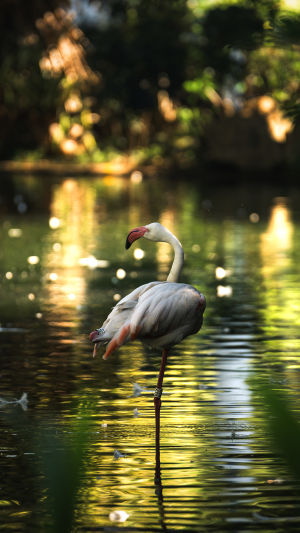
Flamingos are one of the most recognizable birds in the world, thanks to their tall, graceful necks and vibrant pink feathers. But there’s much more to these beautiful creatures than their striking appearance.
From their intriguing feeding habits to their complex social structures, flamingos are a true marvel of nature. Whether they’re wading through shallow waters or performing elaborate courtship dances, they never fail to captivate. Let’s explore what makes these birds truly unique.
<h3>Flamingos Get Their Color from Food</h3>
<b>The Secret Behind Their Pink Feathers:</b>
Flamingos are not born pink. In fact, their feathers start out a dull gray or white. The vibrant pink or reddish hue that defines flamingos comes from their diet, which is rich in carotenoid pigments found in algae and crustaceans like shrimp. These pigments are processed in the flamingo’s liver and absorbed into the bloodstream, eventually coloring their feathers, beaks, and legs.
The more carotenoids they consume, the deeper the pink color. Flamingos raised in captivity on a regular diet may lose their signature color and appear pale unless given a carotenoid-rich diet.
<h3>Flamingos Have Unique Feeding Techniques</h3>
<b>Filter Feeders with a Twist:</b>
Flamingos are filter feeders, but their method of eating is quite unusual. They feed by submerging their beaks upside down in the water. Using a specialized filtering system, they separate algae, crustaceans, and other tiny organisms from the water. Their beaks contain comb-like structures called lamellae, which help strain food efficiently.
This feeding behavior may look unusual, but it is highly effective and perfectly adapted to their environment.
<h3>They Are Known for Their Social Behavior</h3>
<b>Flamingos Live in Large Colonies:</b>
Flamingos are highly social creatures, often found in large colonies that can include thousands of individuals. These colonies serve several purposes: they provide protection from predators, facilitate mating, and help with feeding. In these large groups, flamingos engage in synchronized behaviors, such as communal feeding, nesting, and even dancing.
Flamingo colonies can be extremely noisy, with the birds communicating with each other through various vocalizations. These include honking calls and high-pitched screeches, which help maintain cohesion within the group.
<h3>Courtship and Mating Rituals</h3>
<b>A Synchronized Dance:</b>
Flamingos are famous for their elaborate courtship displays. When it's time to find a mate, both males and females participate in synchronized dances, involving head bobbing, neck stretching, and even walking in unison. This behavior is a way for flamingos to impress potential mates and demonstrate their fitness for reproduction.
Interestingly, flamingos form long-term pair bonds. Once a pair has been established, they will often mate for life and return to the same nesting sites year after year. These bonds are essential for raising their young, as flamingos work together to protect and care for their chicks.
<h3>Flamingos Can Stand on One Leg for Hours</h3>
<b>A Clever Survival Behavior:</b>
Flamingos are often seen standing on one leg, a behavior that has puzzled scientists for years. While the exact reason for this behavior is still debated, several theories suggest that standing on one leg helps flamingos conserve body heat. By tucking one leg under their body, they reduce the amount of heat lost to the water, especially in cooler environments.
Additionally, standing on one leg might reduce muscle fatigue, allowing them to rest while still being able to keep an eye out for predators.
<h3>Found Across the World</h3>
<b>A Wide Distribution:</b>
Flamingos are highly adaptable and can be found in a variety of habitats across the globe, from the shallow lagoons of the Caribbean to the salt flats of Africa and Asia. While they are most commonly associated with tropical and subtropical regions, flamingos also thrive in temperate climates.
The species is spread across several continents, including South America, Africa, Europe, and Asia. Their wide distribution is a testament to their resilience and ability to adapt to diverse environments. However, they do tend to prefer areas with warm, shallow waters where they can easily find food.
<h3>Flamingos Have Impressive Lifespans</h3>
<b>Built for Longevity:</b>
Flamingos are known to live long lives. In the wild, they can live up to 20-30 years, and some have been known to live even longer in captivity. Their longevity is partly due to their social nature and the protection offered by their large colonies. By sticking together, flamingos can defend themselves against predators and share resources, increasing their chances of survival.
Interestingly, flamingos often live longer in captivity than in the wild, thanks to a consistent food supply and the absence of natural predators.
<h3>The Flamingo's Enduring Charm</h3>
Flamingos are far more than just beautiful birds. Their unique feeding methods, strong social bonds, and remarkable adaptability make them one of the most fascinating species in the natural world.
The next time you see a flamingo, take a moment to appreciate the science and beauty behind its elegant appearance. These birds are a true example of how nature blends function with beauty in extraordinary ways.


